
Digital Marketing Tips for Agriculture
You produce, grow, breed – but you would like to sell more and make more money with your hard work? New technologies are changing all sectors of business, including agriculture. Especially small and medium-sized farms that want to sell their products directly to consumers can take full advantage of online marketing. Social networks offer an incredibly wide range of possibilities to sell and promote your products.
This training module will briefly introduce some digital tools that can be used to support direct sales from your farm to customers in an online environment. The traditional and less conventional tools are combined with actual tips and examples.
Aims & objectives:
- To increase emphasis on presentation via social networks, websites, etc.
- Briefly introduce several useful digital tools and complement them with practical tips or current trends.
- To promote direct sales from the farm to the consumer via digital tools.
- Website, the backbone of modern marketing
- Social networks, the tool of today
- Newsletters are not dead
- Successful Marketing Funnel
Website, the backbone of modern marketing
Although a website can certainly no longer be considered an innovative tool these days and a large number of entrepreneurs across industries are using them, it is not out of place to mention this tool right at the very beginning. In agriculture, it is especially crucial that “a quality product deserves a quality presentation“. Thus, we will focus in this material mainly on the product part of the website, which is (not only) on e-shops very often underestimated. If you have already brought potential customers to your website, it would be a shame to lose them because of common and easily solvable mistakes. So what should a product part of a website have?
1. User-friendly environment and navigation
- The website should be user-friendly and provide only the information that the customer really needs.
- Detailed information, technical specifications, etc. can be easily “hidden“ under other tabs/links and do not overwhelm the web with information that the customer does not need at the beginning of the search and orientation.
2. Well-formulated product descriptions
- Focus on what is your competitive advantage, why the customer should buy at your store. Stick to arguments and facts, but don’t be afraid to connect them with positive emotions.
- However, do not forget what is mentioned in the previous point. Try to stay away from lengthy narratives and product descriptions. We know that you can talk about your products for hours, but long texts really tend to discourage customers.
- Make sure you have a well-chosen and consistent style and tone of voice that matches your target audience and do not forget to check grammar regularly and carefully.
3. Design matters
- The visual side of a website is extremely important and customers are placing more and more demands on it. Customers often cannot see your products in reality, so you need to bring them as close to the screen as possible.
- Avoid stock images, the cost of professional product photography is not very high and will ensure your product is portrayed in good light and quality.
4. Optimization and regular updating
- SEO or search engine optimization is the foundation of any successful e-shop. Without it, only a small fraction of potential customers will reach you. However, since it is a rather complex discipline, it is advisable to leave this work to the experts.
- Keep the website updated. A website that hasn‘t been updated for several years can discourage visitors before they even click through your products.
Tips and Tricks:
- You can easily raise awareness of certain products by marking them as ”New”, ”Tip”, etc.
- Discounts and special offers are still the biggest attraction! Avoid artificially inflating prices before a discount though. Firstly, it’s illegal in many countries and secondly, once your customers realise it, they won’t just forgive you.
- Reviews can be a great motivation to buy, but be prepared for negative ones too.
- If you do not want to update the website regularly, avoid the “news section” or displaying the date when news or posts were added, etc. If possible, formulate the text in a timeless way.
According to the latest Eurostat statistics (2023), more than 58 % of people in the European Union use social networks. The average time people spend on social networks per day is over two hours. Social networks are therefore a great opportunity for companies and entrepreneurs to reach customers and sell them your product or service. But how do you choose the right platforms? First, a few points to consider…
- Be aware of what content you are able to produce on a regular basis – quality videos, engaging photos, short texts, interesting facts, …
- Who are your customers and what social networks do they use the most – current statistics available online will be helpful
- Focus on no more than 2-3 platforms – with social networks it is even doubly true that quality (or content) has priority over quantity (number of social networks)
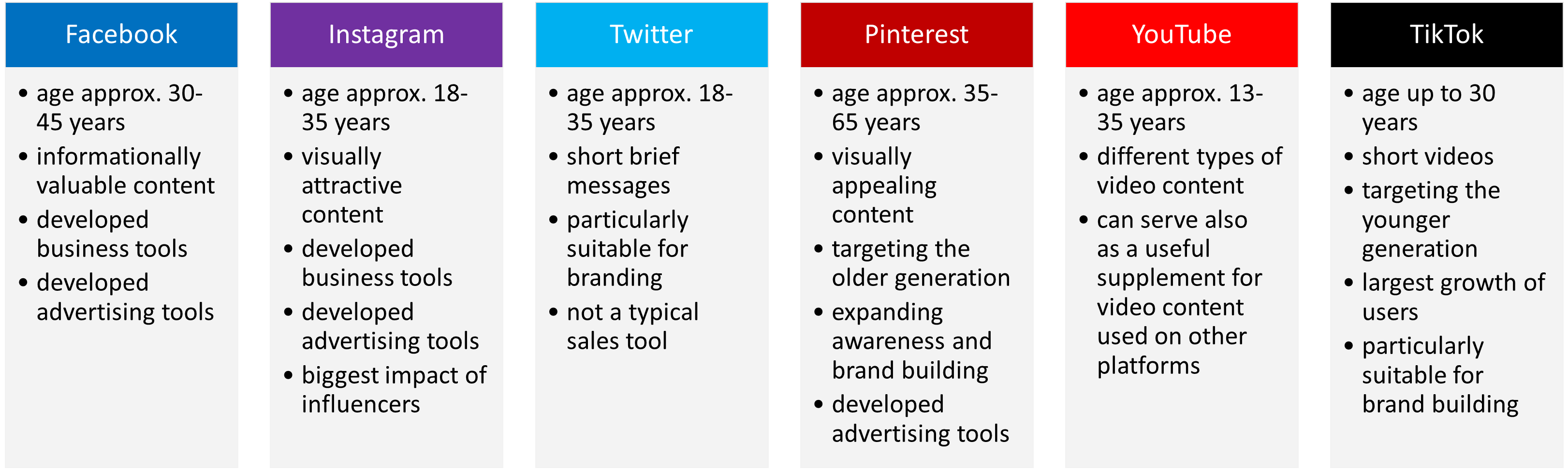
Social networks and trends in 2023
- The trend of short videos from 2022 continues, whether in the form of main content or stories
- Be authentic and engage owners or managers, more than 70 % of customers will appreciate their personal involvement!
- Use social networks for direct sales, more and more users prefer them as a starting point for purchase.
- Sustainability and environmental topics will be one of the central themes for 2023, take advantage of it!
- Advertising should be targeted and concrete, repetitive advertisements are discouraging more and more customers.
Tips and Tricks:
- When searching which social networks your target group uses the most, try to also find out if they prefer to use them on their computer or smartphone. This can also help you decide and, most importantly, set up your content appropriately.
- Keep the information about each product simple and smart, and try to send the audience to the website where they can find an up-to-date and more detailed version of the product description.
- Use social networks not only for sales but for visibility and building your brand and products.
- If you use Facebook or Instagram, do not forget about “stories”. They are regularly viewed by 70-80 % of users of these platforms. For stories, focus more on sharing the daily life your business goes through. Try to post at least one every day!
- See if there are local alternatives to social networks and platforms in your area. For example, online farmers’ markets are becoming popular, especially in big cities.
You have probably already heard the opinion that with the massive rise of social networks, written text is already out of date – and so is email marketing. But statistics show the opposite. When it comes to returning on investment, newsletters are still the most effective marketing tool today. The biggest advantage is the lower cost and the wide reach across generations and target groups. But you need to know how to make them work.
- A quality contact database is essential – here again, quality wins over quantity. GDPR compliance and explicit consent is a must. Do not be afraid to collect contacts offline, for example in a shop.
- Have a plan and strategy – do not send newsletters without any plan and do not push the frequency too far. For large farming companies with a wide range of products, sending out newsletters up to once a week may work, for smaller companies and farms with a narrower product portfolio, once a month will be sufficient.
- Be creative with an engaging subject line and content – an engaging subject line and text determines whether or not the recipient opens the newsletter/email. Also, think about the email address from which you are sending the newsletter and the short text that appears in the email list (preheader).
Tips and Tricks:
- Do not forget to optimise the text for viewing on a smartphone or tablet, as almost half of the people read it here.
- Many users do not see images in emails at all, so put key information in the form of text, not a banner.
- Test different campaigns and do not forget to evaluate them!

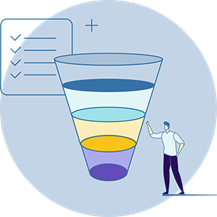
The purpose of a marketing funnel is to convert casual passersby, online visitors and followers, into regular content subscribers and especially regular customers. The tools mentioned in the previous chapters will now be used to build this funnel. Thus, we can use the possibilities of digital marketing to the fullest and reach out to people outside our target group in order to expand our customer base. The funnel then illustrates the step-by-step process in which we try to move potential customers (and lose as few as possible) along the path to the actual purchase.
There are many more developed models, but these basic 4 steps should belong to each of them:

1. Awareness
- Let people know about you. This is well served by social media activity and advertising, good search engine rankings, optimized SEO, articles about the company on partner websites, participation in events, interviews, podcasts, etc.
2. Engagement
- At this stage you have already raised the interest of your potential customers, they know about you and want to know more. This is where the design and functionality of your website or social media accounts come into play. This is also the best time for you to gather their contact or get them interested enough to follow you further.
3. Consideration
- Now you need to gain the trust of the potential customer and show them that your product or service is the best option for them. This is where the use of email marketing, newsletters, special offers, etc. comes into action. Consistency is key!
4. Conversion/Action
- The conversion from visitor to customer is done with the first successful purchase. At this stage, it is important to leave a good impression (helpful staff, well-packaged goods, timely delivery, friendly complaint resolution…) Because even the best marketing funnel will not work if the customer has a bad experience at this stage!
Tips and Tricks:
- To gain wider reach/awareness, try to focus not only on the visual aspect but also on the memorability of the brand (e.g., slogan)
- If you are comfortable with it, try to show one person related to the brand (simply what he/she does) so that the audience can relate in a more “human” way to the posts they see. A familiar face will always be a good method to be memorable and get higher engagement.
- If you realize that something you posted was liked more than other things, then you have a clear answer from the audience. You should start from there and keep on going with the same content that had been appreciated since it’s what caught the attention.
- There will always be some places where your customers leave. Do not worry about it, it is normal. However, you should try to detect excessive losses and try to avoid those in the future.
Sources:

