Innovative Farm to Fork Solutions
While innovative farm to fork solutions can improve environmental or social sustainability in agriculture, it can also help you to grow your business. In this module we aim to describe the most common areas where innovation in agriculture occurs and illustrate these with some of
This module aims to inspire readers to find innovative farm to fork solutions by presenting them the case studies collected within ON-FARM. The aim is to fulfil the following objectives: description of the most encountered solutions in our case studies; and motivation to read more in detail about these solutions in the following modules.
The solutions found in our case studies. The ultimate goal is to encourage you on your path towards more sustainable farming systems.
- Previous notes
- Some innovation areas
- Conclusions
As you have probably seen, in the ON-FARM project, we have produced various results, with the intention of giving you the basic tools to move towards more sustainable models of agriculture.
One of these outputs has been the catalogue of Case Studies, a series of best practices of farmers from partner countries who already do farm-to-fork sales and produce value-added farm products via their own food processing.
Some of these challenges and areas where farmers have had to innovate to survive in their occupation were already described by other authorities and institutions, such as ENRD (European Network for Rural Development), or EIP-AGRI (European Innovation Partnership ‘Agricultural Productivity and Sustainability’). In this module, we have tried to simplify some of these areas of innovation and relate them to the concrete case studies we have collected. These areas that we will describe in the next chapter are: product development; marketing; logistics; and digital innovation.
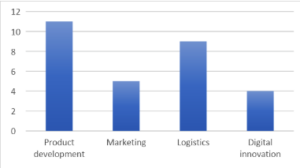
The following graph gives an overview of the areas of innovation where our case studies are included:
Figure 1: Number of case studies per area of innovation
1. Product development:
Product innovation is one of the areas where most innovations are occurring in farm to fork solutions. Innovations are related to the type of product, but also to its relationship to the rest of the short food chain.
A great example of Product innovation is the Favamole from Andres Jara’s farm in the Netherlands. On this farm, they are making a guacamole-like dip out of fava beans to counteract the unsustainable consumption of avocado.
You can learn more about how to create added value to farm products in Module F of these Inspirational Learning Materials.
2. Marketing:
Acquiring short food chain marketing skills is key to developing your business. This area of farm to fork solutions involves understanding the relationships between farmers and consumers, and bringing consumers closer to your products.
The innovative solutions that we have discovered in our case studies have focused on digital marketing, such as the case of Deckers Biohof in Germany, where a delivery service was created. This service entails customer service and communication department, among others.
You can find more information about digital marketing in our Module D.
3. Logistics solutions:
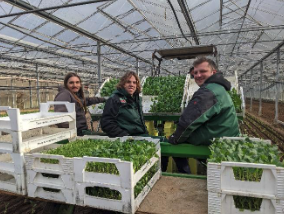
Logistics and distribution are essential parts of food chains, which often reveals themselves impossible to arrange for small farmers because of high prices or lack of organisation-capacity.
Cooperation and self-organisation between producers and consumers is therefore a very positive and common solution among innovative farm to fork solutions, even if it is difficult to initiate.
In our case studies, we can highlight the launch of a network of vending machines for the products (meat machines) of Farma Basařovi in Czech Republic.
More information about SFSC collaborations is accessible in Module C.
4. Digital innovation:
We have already mentioned how important digital marketing skills can be in our initiatives, but digitalisation is also important in the short food chain work as a whole.
Digital and technology solutions can range from metadata analysis to use of new technologies in production or automation of tasks. Overall, these solutions will make life easier for many actors involved.
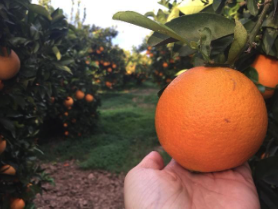
In our compilation of case studies, we illustrate the collection and analysis of multiple data for decision making with the example of Ismael Navarros’ orange farm in Spain. He uses humidity sensors installed in his own farm and the analysis of nearby meteorological centres to improve his decision-making.
In this module we have tried to demonstrate different examples of innovation in farm to fork solutions, taking examples from our case studies.
Although we have highlighted four main areas, this does not mean that innovation stops there. Other areas such as quality and traceability or long-term sustainability will be described in depth in other modules, alongside those mentioned above.
We hope that this short module has given readers inspiration and creativity, and that they will be able to implement innovative farm to fork solutions similar to the ones described or even create their own!