
Partnerships in Short Food Supply Chains
Collaborations are key to establishing short food supply chains and increasing added-value on farms. The module presents different forms of collaborating and cooperating. It describes benefits for farmers and highlights challenges and recommendations.
Aims & objectives:
- Informing about different types of partnerships
- Creating an awareness about the advantages and disadvantages of the different types of partnerships
- Informing about potential solutions regarding challenges in partnerships
- Encouraging collaborations in order to establish short food supply chains
1. Why partner up?
2. Partnerships in short food supply chains
2.1 What is the difference between collaboration and cooperation?
2.2 Forms of partnerships in short food supply chains
3. What are advantages of partnerships for small farmers?
4. How respond to potential challenges of SFSC partnerships?
5. Recommendations for partnerships
Partnerships play an important role in short food supply chains. It can have a significant impact on the success of short food supply chains and can affect different aspects, areas and processes
- It can increase the efficiency, sustainability and resilience of the food system.
- Working together can streamline processes, share resources and knowledge, and reduce costs, especially in the area of logistics (Nsamzinshuti et al. 2017).
- It can also help reach a wider market and create more sustainable local food supply chains by reducing the environmental impact of food transport, often due to shorter distances (EIP-AGRI 2019).
Partnerships between governments, private sector organisations, universities and research centres, and community groups can help develop and implement policies and regulations that support short food supply chains, such as funding for local food initiatives and zoning and land-use regulations that encourage local food production (Jarzebowski et al. 2020).
Another important issue is community engagement. Collaboration between local community groups and organisations, government and private sector organisations can help to engage and involve local communities in the development and maintenance of short food supply chains. This can include community gardens, food co-operatives and other community-based initiatives.
Short food supply chains or alternative food networks are usually made up of a number of stakeholders rather than just one farm or company. The different partners are responsible for different tasks to manage or contribute to the short chain or alternative food network. Working together can strengthen the partnership through a more efficient and effective division of labour, the pooling of resources such as machinery, facilities, products or knowledge, and financial resources. But there are also challenges to working with other farms, businesses or people. A clear understanding of the partnership and relationship and good communication are essential to avoid misunderstandings and conflicts. It is therefore important to establish the right partnership that suits the purpose and all the partners involved. In the following, we introduce the term collaboration as opposed to cooperation. Based on this distinction, we will introduce different forms of partnerships and conclude with barriers and how to overcome them.
Collaboration refers to the process of working together with one or more people to achieve a common goal or objective. It is important to emphasise that collaboration exists to achieve a common goal, outcome or mission. This may involve sharing information, resources and skills, and coordinating efforts to achieve a desired outcome. For example, a group of farmer collaborates in a cooperative to sell their products.
In contrast, cooperation is when a group of people work to achieve the goals of someone else’s project (furthering their goals). It includes helping each other in the spirit of good colleagues or neighbors. It can also include business partnerships where one is providing a service for the other but without a greater common goal. For example, a delivery service coordinates the estimated demand of vegetables with the supplying farms in order to match supply and demand in an efficient way for producers and delivery service.
In the context of SFSC, collaboration refers to the process of working with a group of people to establish and maintain a local food system that links food producers with different actors, often within a defined geographical area. The intention is often to create more sustainable, resilient and equitable food systems that benefit all stakeholders.
Collaboration and cooperation are two different forms of partnerships, both valuable to its specific context. In SFSCs, they can take place along the value chain, such as production and distribution, marketing and promotion, or infrastructure and logistics. (Renkema et al. 2022). Machinery may be shared, partners may build or share facilities, cooperate in marketing and sell products through each other’s channels. (https://blog.jostle.me/blog/collaboration-vs-cooperation; Jäger and Piscicelli 2021). As a result, the process of collaboration involves different actors in the food system. For example, exchanges take place not only between farmers, but also with other types of actors, such as extension services, non-governmental organisations (NGOs), government agencies or consumers. They participate in the collaboration in different ways such as sharing their knowledge and experience, providing support, funding, research and other resources to facilitate the success of the collaboration (Nsamzinshuti et al. 2017).
Farmers can cooperate in different ways. A distinction can be made between market-based partnerships, where partners cooperate based on market price at the time of exchange. This type of partnership is very flexible, focused on the short term, but can last very long. Because the terms of the buy/sell are negotiated for each transaction, the partnership is characterised by a very balanced distribution of risk.
Constant negotiation is not necessary when two parties enter into a contractual relationship as buyer and seller. The objective of the cooperation or collaboration is clearly defined in the contract, which provides the framework for the collaboration. It defines what is to be delivered or provided, when and for how much. These clear conditions minimise the risk for both parties, but at the same time reduce the flexibility of at least one of the parties. The party with the stronger bargaining position can strongly influence the terms of the partnership and set deadlines, quality standards and prices. Therefore, the relationship in this partnership is considered to be based on a hierarchy.
Balanced power structures occur in networks and relational collaborations between equal partners. It is coordinated by common goals. This type of partnership requires a high degree of trust and transparency. They therefore involve a great deal of communication, which can increase the cost of this type of partnership. However, this type of partnership can be highly productive and therefore create a high level of synergy for all partners involved, which makes it worth the effort.
The characteristics, advantages and disadvantages of governance mechanisms vary and can have very individual and specific features and hybrid forms. Figure 1 illustrates applications and examples of SFSC collaboration.
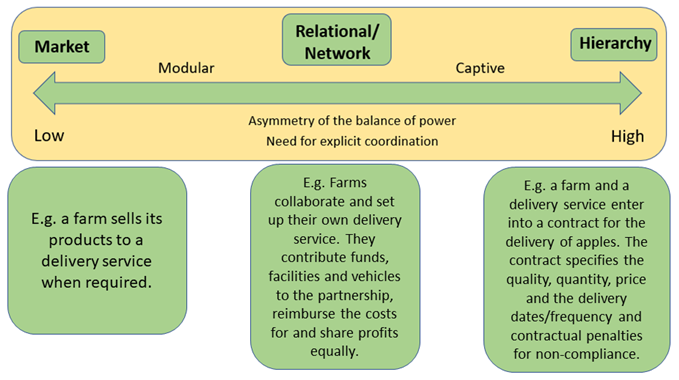
Figure 1; Forms of partnerships adapted from: Gereffi, G. Humpfrey, J. and Sturgeon, T. (2005): The Governance of Global Value Chains. Review of International Political Economy 12 (1): 78-104
The partnerships cannot only be characterized by its mode of governance. Other aspects of collaborations are the following:
- Formal vs. informal: Collaborations can be formal or informal, meaning they can range from legally binding agreements, such as a partnership or joint venture, to less formal arrangements, such as loose networks of individuals or organizations working together.
- Vertical vs. horizontal: Collaborations can be vertical, meaning they involve partners working together at different levels of the supply chain, such as farmers, processors, and retailers. Horizontal collaborations involve partners working at the same level, such as multiple farmers working together e.g. to sell a bigger variety of products (Nsamzinshuti et al. 2017)
- Public vs. private: Collaborations can involve public sector partners, such as government agencies or non-profit organizations, and/or private sector partners, such as businesses or corporations.
- Short-term vs. long-term: Collaborations can be short-term, such as a one-time project, or long-term, such as a continuing partnership or joint venture.
- Profit vs. non-profit: Collaborations can be for-profit, meaning the partners aim to make money from the collaboration, or non-profit, meaning the partners aim to achieve a social or environmental goal.
There can be several benefits for farmers in working together in SFSC. Collaboration can help smallholders share resources and reduce costs by working together on things like shared processing facilities, equipment and transport. This can help them save money and increase their efficiency (Jäger and Piscicell 2021). Sharing knowledge and learning from each other’s experiences can also help. For example, smallholders can become more resilient to climate change and other environmental and economic disruptions by sharing resources and knowledge and diversifying their income streams (Jarzebowski et al. 2020).
Collective marketing and promotion can increase their visibility and marketability. This can include shared branding, packaging and advertising, which can help them reach a wider audience and increase sales.
Working with other farmers or local organisations can help smallholders reach a wider market and diversify their customer base. This can be particularly important in areas where there are few direct marketing channels. Another benefit is to increase their access to markets by linking them with processors, distributors and retailers. This can help them sell their products more easily and at a higher price than if they sold individually. By joining forces with other farmers, smallholders can have more bargaining power when negotiating with buyers or facing other challenges (Jarzebowski et al. 2020). Collaboration also helps smallholders access funding for projects and initiatives that they may not be able to access individually. This can include government grants and loans, as well as private sector investment (Renkema et al. 2022).
Collaboration can also help build stronger links and relationships between producers and consumers. By working together and building relationships, producers can better understand their customers’ needs and preferences, and consumers can learn more about the sources of their food and the people who grow it. This can help them build customer loyalty and increase sales (Pascucci et al. 2016).
There can be several benefits for farmers in working together in SFSC. Collaboration can help smallholders share resources and reduce costs by working together on things like shared processing facilities, equipment and transport. This can help them save money and increase their efficiency (Jäger and Piscicell 2021). Sharing knowledge and learning from each other’s experiences can also help. For example, smallholders can become more resilient to climate change and other environmental and economic disruptions by sharing resources and knowledge and diversifying their income streams (Jarzebowski et al. 2020).
Collective marketing and promotion can increase their visibility and marketability. This can include shared branding, packaging and advertising, which can help them reach a wider audience and increase sales.
Partnerships offer a wide range of benefits as they are describe above. As different forms of partnerships have diverging benefits, it is important to be open about the own goals and respect the objectives of the partner(s). Nevertheless, if the form of partnership does not match the objectives of the individual partner, establishing and maintaining partnerships can lead to conflicts between the involved parties (Jarzebowski et al. 2020). However, for any potential challenge, there is a solution. Some challenges and risks are common and part of any business activity:
Difficulties in finding the right partner: Lack of visibility and information sharing between producers can make it difficult to identify the right partners.
- Solution: Share your idea within your regional network of small producers and ask for interested parties or contacts to potential-ly interested people or existing initiatives.
- Recommendation: Take your time getting to know potential partners. Test working together in individual projects such as pop-up shops, market stalls, organising events such as a farmers’ market, etc. This will allow partners to get to know each other before embarking on a long-term collaboration with a potentially higher financial risk.
- Recommendation: Instead of making a financial contribution, some partners may be able to contribute existing equipment or facilities in return for a fee or their own working time. This reduces the necessary investment and financial risks, especially at the beginning of a collaboration.
Keeping the momentum going: As with any business, collaborations can be difficult to sustain over time, as partners may lose interest or have other priorities. This can make it difficult to maintain the momentum and continuity of the collaboration.
- Solution: Be aware of the different phases of collaborations and manage projects and challenges accordingly. In the establish-ment phase, it is important to develop working processes. In the next phase, the collaboration should focus on growth, followed by a consolidation phase.
- Recommendation: Products and processes should be evaluated and new markets assessed in order to remain competitive.
- Key fact: In general, the depth of collaboration and the degree of integration have a direct impact on the financial links between the partners.
- Solution: As mentioned above, collaborations can reduce the financial burden by sharing it with partners.
- Solution: Material contributions or working hours can also reduce financial barriers by reducing the average investment per partner.
A lack of trust and communication can have a negative impact on collaboration. A good relationship of trust is an important basis for successful collaboration.
- Solution: Open and frequent communication and a transparent way of working within the partnership can prevent losing trust. Good communication is therefore essential for effective collaboration.
- Recommendation: In this case, cooperation is likely to be the better approach. A more market-based relationship, through flexi-ble buyer-seller relationships or even a contractual relationship to produce or market a certain quantity of a product, can reduce the need for coordination and decision making and define clear penalties for delays or other conflicts.
- Recommendation: In networked and hierarchical collaborations, it is important to have clear agreements.
- Solution: If common understanding remains an issue, market-based cooperation may be a solution.
- Key fact: A digital infrastructure is often the basis for any kind of enterprise resource planning system, logistics, web shops, etc. It is therefore important to understand the needs of the collaboration on the one hand and the user experience of customers or business partners on the other. The use of digital solutions is a good example of the benefits of partnerships, as it allows farmers to focus on production. Instead of dealing with the whole IT system, they only have to use their interface to the digital solution of the partnership.
- Solution: A collaboration should invest time and/or money in identifying the right solutions for its purpose, if there is insufficient knowledge of digital solutions including operating skills.
As outlined above, partnerships are often the key to successful SFSCs. Based on the success factors and barriers identified above, it should be remembered that SFSCs are very diverse in terms of their structure. Any measures to support collaboration or cooperation in these initiatives must therefore take into account the organisational structure, objectives and activities of the chain (Jarzebowski et al. 2020).Farmers should/must consider different aspects when entering into collaborations and during their implementation:
- Clear goals and objectives: Farmers should set clear goals and objectives for the collaboration and ensure that all partners share these goals and are committed to working towards them. All partners in the collaboration should have clearly defined roles and responsibilities and understand how their actions contribute to the overall success of the collaboration.
- Shared vision and values: Collaborations should have a shared vision and values that are consistent with the goals of the collaboration.
- Legal and regulatory compliance: The collaboration should ensure that it complies with all relevant laws and regulations, including labour laws, health and safety regulations and environmental regulations.
- Financing and investment: Farmers should be aware of, manage, and be prepared to mitigate financial and operational risks, such as delays or disruptions in supply chain operations. The collaboration should have a clear plan for financing and investment, including a budget and sources of funding.
- Flexibility and adaptability: The food system and market are constantly evolving, and the collaboration must be flexible and adaptable to be successful. This includes being open to feedback and making adjustments as needed.
- Long-term viability: Farmers should consider the long-term viability of the collaboration and ensure that it is sustainable and resilient over time. The collaboration should have a plan for maintaining continuity, including identifying potential successors and successors in case key partners leave the collaboration.
- Evaluation and monitoring: The collaboration should have a plan for evaluating and monitoring progress and making adjustments as necessary.
- Strong leadership and management: Collaborations should have strong leadership and management to ensure that they are well coordinated, well structured and well managed.
- Communication and trust: Farmers should establish open lines of communication and work to build trust with their partners. This includes being transparent about their intentions and willing to listen to others’ concerns and ideas. Partners should be transparent about their intentions and willing to share information and resources.
- Power imbalances: Farmers should be aware of power imbalances between partners and work to ensure that all partners have an equal say in decision-making and access to resources.
- Community involvement: Farmers should consider the role of community engagement and ensure that collaboration is inclusive and benefits the local community.
(Halkier und James 2022; Pascucci et al. 2016; Jarzebowski et al. 2020; Renkema et al. 2022).
References and links:
- EIP-AGRI (2019) online: eip-agri_brochure_short_food_supply_chains_2019_en_web.pdf (europa.eu).
- Gereffi, G. Humpfrey, J. and Sturgeon, T. (2005): The Governance of Global Value Chains. Review of International Political Economy 12 (1): 78-104
- Halkier and James (2022): Learning, adaptation and resilience: The rise and fall of local food networks in Denmark. Journal of Rural Studies (95) 294–301.
- Jarzebowski, S., Bourlakis, M. and A. Bezat-Jarzebowska (2020): Short Food Supply Chains (SFSC) as Local and Sustainable Systems. Sustainability (12): 1-13.
- Kleine Jäger, J. and L. Piscicelli (2021): Collaborations for circular food packaging: The set-up and partner selection process. Sustainable Production and Consumption (26): 733–740.
- Martens, K., S. Rogga, J. Zscheischler, B. Pölling, A. Obersteg and A. Piorr (2022): New Hybrid Cooperation Models for Short Food-Supply Chains—Providing a Concept for Assessing Sustainability Transformation in the Urban-Rural Nexus. Land (11) 1-24.
- Nsamzinshuti, A., Janjevic, M., Rigo, N., and A. Ndiaye (2017): Logistics collaboration solutions to improve short food supply chain-Solution performance. Proceedings of the 3rd World Conference on Supply Chain Management (2) 57-69.
- Pascucci S., D. Dentoni, A. Lombardi and L. Cembalo (2016): Sharing values or sharing costs? Understanding consumer participation in alternative food networks. NJAS – Wageningen Journal of Life Sciences (78) 47–60.
- Renkema, M. and P. Hillefofth (2022): Intermediate short food supply chains: a systematic review. British Food Journal (124) 541-558.

