PROJECT ON-FARM
TITLE OF THE CASE STUDY
Shiny and organic honey
MAIN DATA OF THE COMPANY
Name of the Company
Luz de miel
Country
- Spain
Type of the Company
- Individual company
Farming Activity
- Animal breeding
- Product’s transformation on farm
Direct selling way
- Direct selling in farm
SELF – INTRODUCTION OF THE FARMER
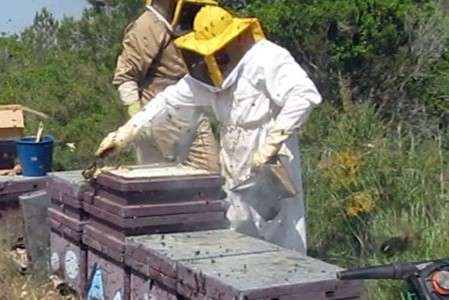
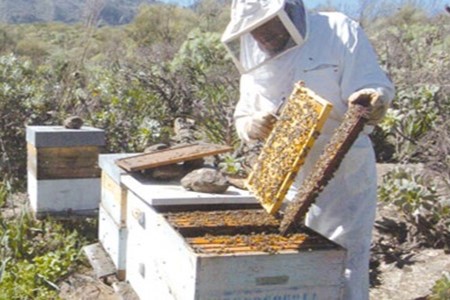
José Luis Delgado started as a young farmer in 2003. He has managed 300 hives, although he is in the process of converting to organic farming. This conversion has reduced his production capacity for various reasons (management and pests). He now has 150 hives. He also manages 9 ha of olive groves and 7 ha of organic cereal and some organic vegetables (very modest in the latter case). The main activity, from which he gets the most income, is beekeeping. He manages the farm himself, although he has family support (wife and two children) for occasional tasks such as olive harvesting. He sells very little honey and vegetables directly, since he sells the cereal and olives, for example, to the oil mill. He does sell some oil or chickpeas, but it is not very representative.
CHANGES / INNOVATIVE SOLUTIONS ADOPTED
Innovations introduced in the farm have been mainly been to obtain the sanitary registration to be able to make direct sales in the production of honey and the conversion to organic farming.
WHY AND HOW YOU DECIDED TO INTRODUCE STRATEGY CHANGES / INNOVATIONS
Since it began, it has introduced several innovations. First, to obtain the sanitary registration to be able to make direct sales in the production of honey. He had to carry out works in order to set up the premises and obtain the registration. He was able to apply for a grant to be able to afford the work. Direct sales have been fundamental to survive in the market, since selling in bulk only generates losses. The big industries have greatly lowered prices, taking advantage of imports of Chinese honey, of very low quality, which is mixed with native honeys. The labeling rules have favored this type of practice, and although they have tightened their control somewhat, they continue to be practiced in different ways, which is a fraud to the consumer. Another innovation has been the conversion to organic. This conversion has been motivated by personal conviction, since the use of chemicals to treat certain problems such as varroa was becoming unsustainable, not only for the environment, but even for him.
WHAT OBSTACLES DID YOU MEET
Fortunately, there have been no obstacles to direct sales. It belongs to a Protected Designation of Origin "honey from the Alcarria" which enjoys a very good reputation. In fact, until now he has been selling his entire production at his farm, without the need to go to markets or on the Internet. However, the conversion to organic made in 2013 has been an upheaval. The elimination of chemicals has meant a significant loss in hives, which he now believes he has been able to stabilize at 150 hives. This has meant a drop in the census by half, since the management practices are more complex. Now, for example, he has to cage the queen to combat varroa, which seems to have become resistant to several chemical products. These practices are more costly, especially in terms of time. The big problem of all this is that he has had to increase prices, which means that he is having to go out to the market to sell, especially consumer groups in Madrid and that he will soon open an online store, now that he has been able to stabilize production. Although the production is organic, the packaging is not yet certified organic. This has made it even more difficult to sell, as it cannot label it as organic, and has had to focus on consumer groups, with people with whom it had a close relationship.
EVALUATION OF THE RESULTS
Direct sales have been the only option I had to survive in a market where bulk sales are highly penalized. Fortunately, he is in a privileged area, where honey is a highly valued product. He does not have to transhumance, which means that he has a lower production, but also higher prices. The change to organic is a long-term commitment that he has made out of personal conviction, but in the long run it will bring greater benefits. These will come in the first place by the production itself. Beekeeping is a small sector, with little research and a lot of very comfortable beekeepers. To fight against varroa, one of the great problems of beekeeping, a lot of chemicals have been used that little by little have created resistances, which makes these treatments more and more ineffective. Changes in management such as queen caging, almost obligatory in organic farming nowadays, are now much more effective, although they mean a loss of production, since they require longer stops, as well as a lot of expertise and much more time. He believes it is possible to find a niche market for this high value-added honey, but at almost double the price. Only small farms can offer these products, but of course, it requires more effort in marketing. It is necessary to explain to the consumer face to face which are the characteristics that differentiate it, besides the organoleptic characteristics and the quantity produced can vary enormously from one year to the next, mainly due to the climate.
WHAT WOULD YOU DO DIFFERENT AND WHAT ARE THE PERSPECTIVES IN YOUR MIND
I could not have done anything different. If he had not done what he has done, he would have left the farm. He believes that continuing down the path of conventional beekeeping would have gone against his principles. Selling honeys with large amounts of chemical residues in direct sales markets, being aware of what you are selling, he does not think it would be honest with him, nor with the consumer. Furthermore, the use of these chemicals would have been detrimental to his health, to his family and to his natural environment. On the other hand, if he had not started direct sales, it would have meant the disappearance of his farm. It would have meant depending on these industries that do not value production.
FINAL SENTENCES
General Evaluation
Since he returned to the village, picking up a little land from his family, he has managed to maintain and evolve from his beginnings in beekeeping. He started with many hives and selling in bulk and little by little he has been specializing in direct sales to the consumer, due to the inertia of the market. The increasing dependence on chemical products made him abandon conventional activity to go to organic, in which he still has investments to make to make the complete conversion. Its limited resources make this transformation gradual (it still has to do the packaging). But he is very clear that it is the way he has chosen to produce, sell and live in the rural environment. He could live in another way, for example selling honey that is not his when he lacks it, but he prefers to be honest and try to explain to the consumer, not only that his honey is different, but also to teach him to understand that the countryside is not a factory, that it has that variability and that acting in another way will mean the disappearance of the rural world.
Suggestions for other farmers
Each one has to take into account what their motivations are, based on this each one must follow their own path. He has chosen to have an environmentally friendly farm with a high quality product, which has led him to have a modest farm, in which to survive he considers that the most important thing is to reach the consumer, you have to talk clearly with him, face to face, explain what your product is, how you do it, what makes you different, teach him to appreciate it and to distinguish it, and also to understand what your costs are, because you cannot sell it below your costs. Getting out of the chain, producing and selling on your own is much more complex, but also more beautiful if you do something you believe in. It can also be more frustrating, because if you try to do it well and be honest, it makes you angrier about certain practices, such as selling honey as your own when it is from other producers or when there is consumer fraud with imported honeys.