
Quality and Traceability as Requirement for the Short Chain
This module try to introduce to a professional approach on the short chain’s development. Especially the scope of the module is to demonstrate the strength connection between a relationship producer/consumer and the application of some of the main EU strategies relevant to the quality and traceability of the food production. The operational objective of this module is to learn to the students (especially farmers and food producers) how elaborate a strategy aimed to foster a relationship producer/consumer valorizing farming’s products, adopting:
- the different certification schemes about the origin and/or quality of the products;
- the process certifications (i.e. the certification of organic production methods);
- other type of territorial and/or chain label;
- an information strategy based on the concept of traceability of the production processes.
The final objective is to learn to the student that a professional marketing strategy to develop a successful short chain, must have the main scope to promote a trust relationship with the consumers based on their knowledge and information about the products.
- Short supply chain: a new alliance between producers and consumers;
- The keywords for a successful short supply chain;
- Quality ways and certifications;
- Information and traceability;
- Conclusions
Short chain routes have experienced a significant increase in Europe in recent years. The reasons for this success are mainly the following:
- The need for farmers to increase their income by reducing steps within the supply chain;
- Greater awareness of their social and productive role by farmers;
- Farmers’ need to build a direct and virtuous relationship with consumers;
- Search, by consumers, for genuine, healthy and quality products.
The combination of these factors has determined the success of the many initiatives aimed at developing direct sales paths, through farmers’ markets, points of sale at the farms, company shops or groups of farmers, online sales.
Through these initiatives, a new alliance has been established between producers and consumers, based on the farmers’ commitment to guaranteeing the ‘food safety’ of their products, responding to a target of demanding and attentive consumers, who are also willing to make a greater commitment, both economically and organization, to be sure of a healthy and genuine food production.
In order to develop and strengthen a solid alliance between producers and consumers, it is necessary to develop effective entrepreneurial strategies starting from the identification of some keywords, which must be placed at the basis of the objectives of these strategies:
Trust
The relationship of trust between producer and consumer is the main success factor of the short supply chain. This trust can be established and consolidated through direct knowledge and the personal relationship that is established between the consumer and the producer.
Consumer loyalty can be gained in direct selling markets or corporate outlets. However, the relationship of trust, although very important, cannot be the only key to the success of short chain marketing, for two main reasons:
- The expansive capacity of a short supply chain based on the exclusive personal relationship between producer and consumer would be very limited;
- The relationship of trust must be based not only on empathy, but must be based on assessments concerning the seriousness and professionalism and transparency of the farmer in the management of his production processes;
Quality
This is why it is essential, in an entrepreneurial strategy for the development of the short supply chain, to focus on the full enhancement of the quality of one’s products. As we will see below, the concept of quality is not absolute, but can be declined in relation to the specific needs of the reference consumer target; it can concern the properties of the raw material, the environmental sustainability of the production processes, the wholesomeness of the products and other factors, which can be the subject of certification protocols, which guarantee the required requisites, subjecting farms to a rigorous control system.
Information
More generally, effective marketing aimed at developing a short supply chain must pay great attention to the communication and information strategy, making available the ‘traceability’ of all the elements that may be of interest to consumers; a communication strategy, therefore, which is not limited to an ‘advertising’ approach, but based on an objective, transparent and verifiable information system, which provides the consumer with real ‘knowledge’ of the production reality to which it is addressed.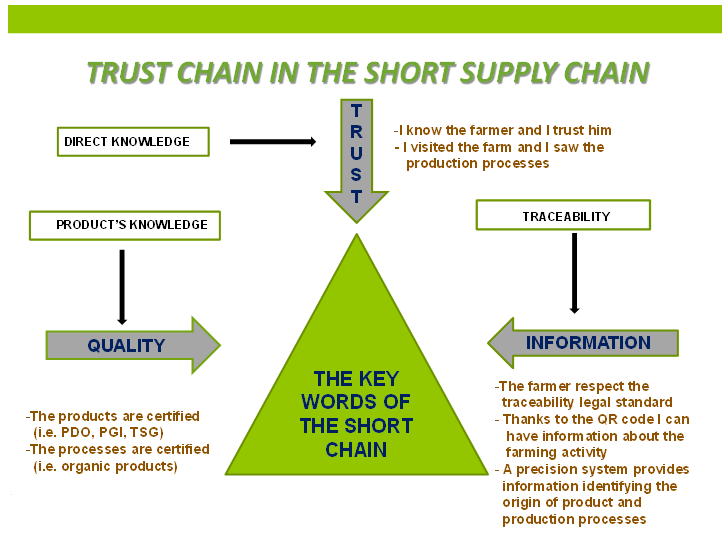
Certification is the main system for enhancing the characteristics of a product . Through the different types of certification, the following can be documented and guaranteed:
- The compliance with health and hygiene and quality requirements;
- The origin of the raw materials and of the finished product;
- The intrinsic characteristics (composition, varieties or breeds used, etc.);
- The quality and sustainability of production processes;
Certifications are divided into mandatory and voluntary.
1. Mandatory self-certification of the hygienic-sanitary sureness
All companies that work and produce goods in the food sector must comply with HACCP self-certification, elaborating a plan identifying the risks in each process of own production chain and the way to solve each critical point.
2. Voluntary certifications
The European Union, as part of its agricultural and rural development policies, has promoted various certification schemes for agricultural production, through specific provisions governing the issue and control of certifications in a uniform manner for all countries of the Union.
As far as agricultural and food products are concerned, European legislation provides for a system of denominations, which define both the origin and the characteristics of the products. The characteristics of the certified products are defined in specific specifications whose management and control are entrusted to the protection consortia of the individual denominations. The main denominations recognized at EU level are:
a. PDO (Protected Designation of Origin)
b. PGI (Protected Geographical Indication)
c. STG (Traditional Specialty Guaranteed
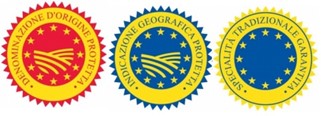
PDO: The PDO mark (Protected Designation of Origin) is a designation registered with the European Community to indicate a typical high quality product , whose area of origin and the traditions used to create it make it so peculiar that it must be protected from counterfeiting. In PDOs, the territory of origin concerns both the origin of the raw material and the development of the entire production process. An example of PDO product is represented by Kalamata olive oil PDO is entirely produced in the region of Kalamata in Greece, using olive varieties from that area.
PGI : The PGI (Protected Geographical Indication) mark has the same purpose as the PDO mark and also certifies the origin of the product. Unlike the PDOs, the PGI certification mainly protects some production processes characteristic of the place of denomination, but not necessarily the origin of the product as a whole. Some example of PGI products are the garlic of Graciosa (PT) or the olive oil of Tuscany (I).
TSG: The term traditional specialty guaranteed, better known by the acronym TSG, is a brand of origin introduced by the European Union aimed at protecting specific products that are characterized by traditional compositions or production methods. A TSG is, in example, the spanish ham called Jamon Serrano.
A separate regulation concerns the wine-growing sector, in which remain previous national designation systems. In Italy, in example, the wine denomination can be DOC (Controlled Designation of Origin) or DOCG (Controlled and Guaranteed Designation of Origin).
ORGANIC PRODUCTION

Turning to the production processes, the main certification recognized at EU level is that relating to production obtained with organic methods . It is a certificate issued by a designated body, which recognizes the achievement of certain standards imposed by the European Union by companies in the agro-food and breeding chain (from the production to the marketing of food products).
In particular, the use of sustainable practices is guaranteed throughout all stages of the production process. The certification, issued at the end of a period of conversion from the traditional method to the organic one, is subjected to the annual control of certified bodies at European level.
In addition to these certifications recognized by the EU, further brands developed at the level of individual countries and territories can be added, which can be, for example, territorial brands, for example of the products of a park or an agricultural district of particular value; or supply chain certifications, which guarantee the transparency of the path through all the steps within a supply chain. […]
The traceability of the food product represents that factor of transparency and information , which guarantees the consumer the possibility of knowing and recognizing the product through all the phases of its production process.
Traceability, allows to describe the path of a raw material or a production lot, within the production chain: from the production phase, to transformation, up to distribution. The traceability implies the possibility of reconstructing the entire journey of a product backwards, from its final state to the starting raw materials.
Traceability was born as a tool to guarantee the wholesomeness of food but it is essential, for example, to certify the origin of a product or the various intermediate steps that led it to the counter of a shop or to our tables. Traceability is also a fundamental condition for demonstrating, in Designations of Origin, the conformity of the products to the production specifications.
As a result of the EC Reg. 178/2002, since 2005 it has become mandatory for all companies in a food chain (from the producer to the final consumer) to identify and guarantee the traceability of a product.
What is required of food sector operators is to be able to trace the previous link and the next in the food chain. But the technological evolution and the digital process, allows to reach more advanced objectives in the field of traceability, giving a while set of information to the consumers. The QR code is an increasing way to enter directly in the farm with own phone. Another example concerns the precision farming, that can collect important information able to define the exact origin of the products.
The development of certifications, combined with the adoption of traceability practices for production processes, beyond the legal obligations, is certainly functional to an information strategy. Both certifications and traceability can represent a factor in consolidating the relationship of trust between producers and consumers, fundamental in a marketing path based on the short supply chain.
The final question for a farmer, after reading this chapter is: is it for me convenient to implement quality, certification and/or traceability system in my short chain strategy? We search to offer some answers about advantages and critical points of this choice:
Advantages
- In principle the possibility to demonstrate to the consumers the quality of the farming activity trough the certification and a correct information, improves and increases a relationship based on the trust;
- For afarmer that search to increase his consumer’s target, the trust relationship with the clients must be based on objective quality guarantees.
- Normally the consumer searching products by local markets and short chain, is ready to pay more a product with the guarantee for quality and sustainability;
- The certification can a required parameter in some farming context. In example, the competitiveness of a farmer producing wine not certified in the area of Chianti or Rioja, could be problematic;
Critical points
- The participation to the quality and certification systems implies for sure additional costs in terms of:
- Involvement in knowledge and respect of the required rules;
- Direct costs for certification.
The add value due to the quality and certification and/or traceability systems could be not sufficient to pay the mayor costs; it depend form the different agricultural context.
In conclusion, our suggestion for a correct approach and improve the short chain is the following:
- Put attention, in the implementation of a short chain, to elaborate a communication and information strategy about the quality of your products;
- Analyze the market context, the requests of your potential clients, the position of your farming activity compared with other farmers of your area and food sector;
- Evaluate the more convenient strategy, the relation between costs and benefits, the needed skills and competences.
- Try anyway to offer to your clients the better quality of your work.
Useful links for a deeper knowledge:
https://food.ec.europa.eu/horizontal-topics/farm-fork-strategy_en
https://agriculture.ec.europa.eu/farming/certification_en
https://ec.europa.eu/agriculture/ofis_public/
https://www.eitfood.eu/blog/how-can-digital-traceability-increase-trust-in-the-agrifood-industry
https://ec.europa.eu/eip/agriculture/en/focus-groups/innovative-short-food-supply-chain-management

